

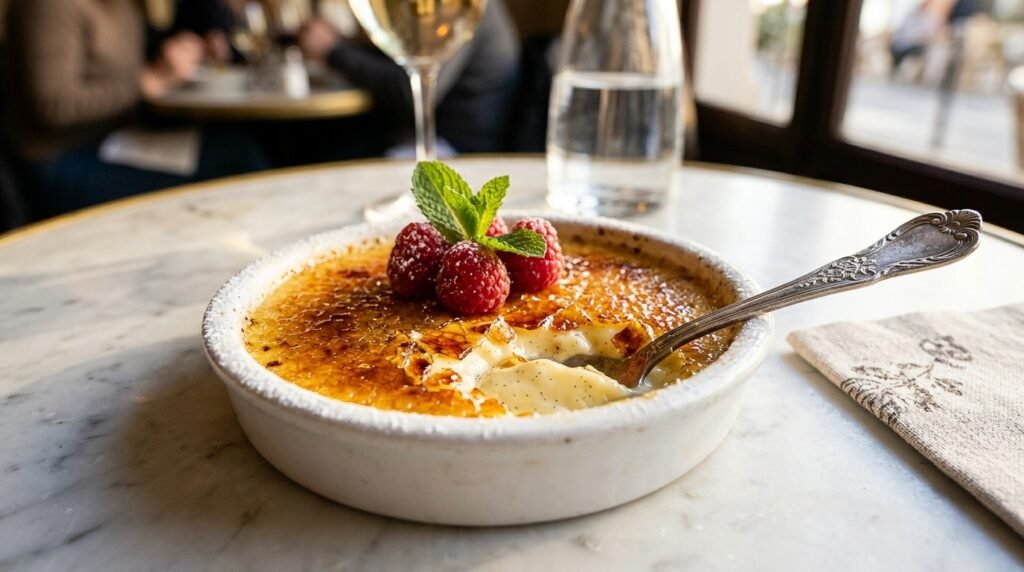
Few moments in international gastronomy match the theatrical sensory ecstasy of gently tapping the back of a silver dessert spoon against a freshly torched vanilla bean creme brulee. The sharp, vitreous crack of the amber caramelized sugar crust giving way to cool, velvety, Madagascar vanilla-flecked silk beneath is the hallmark of elite French patisserie. Despite its intimidating five-star restaurant pedigree, mastering classical French crème brûlée at home requires only five fundamental pantry ingredients, a gentle low-temperature water bath (bain-marie), and an understanding of gentle egg yolk coagulation science.
The Architecture of the Perfect Crème Brûlée
Credited to legendary French chef François Massialot in his 1691 culinary treatise Le Cuisinier Royal et Bourgeois, crème brûlée (literally “burnt cream”) is fundamentally a baked stirred custard finished with a caramelized sugar shell. Unlike Spanish Crema Catalana which relies on cornstarch thickeners and milk, or English Trinity Burnt Cream, classical French crème brûlée uses pure heavy whipping cream (minimum 36% butterfat) and egg yolks alone to achieve its luxurious structural suspension.
When properly baked, the custard should gently wobble like set gelatin when the ramekin is nudged, possessing zero graininess or curdled texture. Alongside our celebrated bakery guides like the Bakery-Style Vanilla Bean Cupcakes and our flaky Classic French Pain au Chocolat, this comprehensive recipe will empower you to produce bistro-perfect crème brûlée in your own home kitchen.
Ingredients & Ramekin Selection Guide
| Ingredient / Tool | Metric Measurement | US Customary | Chef’s Quality Recommendation |
|---|---|---|---|
| Heavy Cream (36% to 40% butterfat) | 480ml | 2 cups (1 pint) | Do not substitute with half-and-half or whole milk; butterfat prevents curdling |
| Madagascar Vanilla Bean | 1 whole plump pod | 1 bean (or 2 tsp vanilla bean paste) | Split lengthwise and scrape thousands of aromatic caviar seeds into the cream |
| Large Egg Yolks | 5 yolks (approx. 90g) | 5 large yolks (room temp) | Egg yolks provide lutein for golden color and natural emulsifiers for satin mouthfeel |
| Granulated White Sugar (For Custard) | 65g | 1/3 cup | Sweetens the custard while raising the egg protein coagulation temperature threshold |
| Fine Sea Salt | 1g | Pinch (1/8 tsp) | Balances the profound richness of the heavy cream and vanilla oils |
| Superfine Castor Sugar (For Crust) | 40g | 4 tablespoons (1 tbsp per ramekin) | Fine crystals melt uniformly under culinary torch flame without scorching |
| Shallow Ceramic Ramekins | 4 wide ceramic dishes (approx. 120ml) | 4 x 4-ounce or 5-ounce shallow ramekins | Shallow wide ramekins ensure ideal 1:1 ratio between sugar crust and custard |
The Science of Low-Temperature Custard Coagulation
To produce a custard that melts like satin on the tongue, one must understand egg protein denaturation. Egg yolk proteins naturally begin unraveling and cross-linking into a solid gel between 65°C and 70°C (149°F–158°F). If heated beyond 82°C (180°F) in a dry oven, the egg proteins contract violently, squeezing out trapped liquid (syneresis) and transforming into rubbery, scrambled sweet eggs.
To prevent this culinary disaster, two safeguards are deployed: first, dissolving sugar into the yolks raises the coagulation temperature to a safer 78°C–80°C. Second, baking the ramekins immersed in a boiling water bath (bain-marie) ensures the ambient temperature surrounding the custard never exceeds 100°C (212°F), yielding an immaculate, perfectly tempered custard.
Masterclass Step-by-Step Method
Step 1: Steeping the Vanilla Bean Cream
Preheat your oven to 160°C (325°F) with the oven rack positioned in the center. In a medium heavy-bottomed saucepan, combine 480ml of heavy cream, a pinch of fine sea salt, and the scraped seeds and empty pod of 1 whole Madagascar vanilla bean. Bring the cream to a gentle simmer over medium-low heat until tiny bubbles form around the perimeter (do not allow it to boil vigorously). Remove from heat, cover the pan with a lid, and allow the vanilla to steep for 15 to 20 minutes to infuse its aromatic oils.
Step 2: Whisking Yolks & Tempering the Custard
In a medium mixing bowl, whisk together 5 large room-temperature egg yolks and 65g of granulated sugar until just combined and pale. Important: Whisk gently by hand; do not whip vigorously with an electric beater, as incorporating air bubbles will ruin the glassy smoothness of the baked custard.
Discard the spent vanilla pod. While whisking constantly, pour a slow, steady stream of the warm vanilla cream (about 1/2 cup at a time) into the egg yolk mixture. This gradual tempering acclimates the egg proteins to the heat without curdling. Once tempered, pour in the remaining cream and gently stir until homogeneous.
Step 3: Straining & Skimming Air Bubbles
Pour the warm custard through a fine-mesh sieve into a spouted liquid measuring pitcher. Straining removes any chalazae (egg white strands) or premature cooked bits, leaving pure vanilla seeds suspended in cream. If you observe tiny foam bubbles on the surface of your custard, pass a kitchen butane torch flame rapidly across the surface or skim with a spoon; bubbles baked into the custard create an unsightly pockmarked surface.
Step 4: The Bain-Marie Water Bath Bake
Arrange four shallow ceramic ramekins inside a deep roasting pan or 9×13 metal baking dish. Divide the custard evenly between the ramekins, filling each almost to the rim. Place the roasting pan onto the pulled-out oven rack. Carefully pour boiling kettle water into the roasting pan around the ramekins until the water reaches halfway up their outer sides, taking care not to splash water into the custard.
Gently slide the oven rack in and bake at 160°C (325°F) for 32 to 38 minutes (or 40–45 minutes for deep ramekins). The custard is done when the edges are set and firm, but the direct center retains a gentle, jiggly wobble when nudged. An instant-read digital thermometer inserted into the center should read exactly 77°C–79°C (170°F–175°F).
Step 5: Chilling to Perfection
Using silicone tongs, carefully lift the hot ramekins from the water bath and transfer them to a wire cooling rack. Allow them to cool to room temperature for 1 hour. Cover each loosely with plastic wrap (ensuring the wrap does not touch the surface) and refrigerate for a minimum of 4 hours, or preferably overnight. The custard must be chilled completely cold before torching, or the heat from the flame will melt the custard beneath.
Step 6: Torching the Glass-Like Caramel Crust
Dab the surface of each chilled custard with a clean paper towel to absorb any condensation droplets. Sprinkle 1 tablespoon of superfine castor sugar evenly across the surface of each ramekin, rotating and tapping the ramekin to create a paper-thin, uniform layer. Tip out any excess loose sugar.
Ignite a butane kitchen culinary torch to medium intensity. Hold the flame 3 to 4 inches away, moving in continuous, gentle concentric circles. The sugar will first bead and melt, then boil and foam into amber caramel, deepening into a rich mahogany gold. Allow the caramelized shell to cool and harden undisturbed for 3 to 5 minutes at room temperature, forming a brittle, glass-like crust. Serve immediately with fresh raspberries.
Frequently Asked Questions (FAQ)
Can I caramelize crème brûlée under an oven broiler without a torch?
While an oven broiler can melt sugar, it radiates heat across the entire dish, warming and curdling the delicate cold custard beneath before the sugar can properly caramelize. A dedicated $15 refillable butane kitchen torch delivers concentrated, instantaneous 1,300°C heat directly to the sugar granules without warming the custard below.
Can crème brûlée be made in advance?
Yes. The baked custard can be prepared, covered, and stored in the refrigerator for up to 4 days ahead of time. However, the sugar crust must be torched no more than 30 to 45 minutes before serving; sugar is hygroscopic and will absorb moisture from the custard and refrigerator air, softening the crackly crust into syrup if chilled after torching.
Delve deeper into exquisite French patisserie with our Artisanal French Almond Croissants and our silky Mini Lemon Raspberry Tartlets.
