

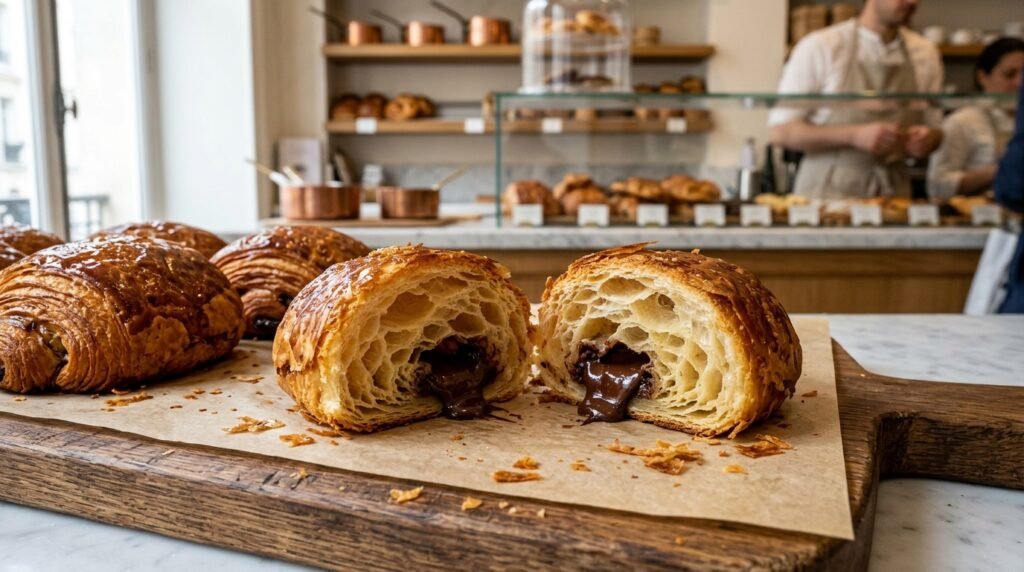
Biting through the delicate, shattered-glass outer shell of a fresh homemade pain au chocolat recipe to reveal an airy, buttery honeycomb matrix wrapped around two molten batons of bittersweet dark chocolate is one of the supreme joys of world gastronomy. While commercial supermarket chocolate croissants are often spongy bread disguised with vegetable shortening, authentic French viennoiserie is an art of patience and temperature control. In this definitive masterclass handbook, you will master the classic French lamination process (tourage), creating 27 micro-layers of French cultured butter and yeast dough that bake into golden patisserie perfection.
Table of Contents
The Architecture of Viennoiserie Lamination (Tourage)
The term lamination refers to the mechanical process of interleaving thin sheets of dough (détrempe) with continuous sheets of butter (beurrage) through successive folding and rolling cycles. During baking at high temperature (400°F / 204°C), the water trapped within the butter layers rapidly vaporizes into steam. Because the butter fat prevents the individual dough sheets from bonding, the steam expands upward, forcing the dough layers apart. Simultaneously, the butter fat fries the thin dough membranes into crisp, micro-thin leaves, producing the legendary alvéolage (honeycomb open crumb structure).
Baker’s Precision Formulas and Metric Hydration
| Component | Ingredient | Metric Weight | Bakers Percentage (%) |
|---|---|---|---|
| Détrempe (Dough) | Bread Flour (12.5% protein) | 250 g | 50% |
| Détrempe (Dough) | All-Purpose Flour (11.5% protein) | 250 g | 50% |
| Détrempe (Dough) | Cold Whole Milk (4°C) | 140 ml | 28% |
| Détrempe (Dough) | Cold Water (4°C) | 140 ml | 28% |
| Détrempe (Dough) | Granulated White Sugar | 60 g | 12% |
| Détrempe (Dough) | Unsalted Butter (softened, into dough) | 40 g | 8% |
| Détrempe (Dough) | Instant Yeast (Gold SAF osmo-tolerant) | 10 g | 2% |
| Détrempe (Dough) | Fine Sea Salt | 10 g | 2% |
| Beurrage (Butter Block) | European Cultured Butter (82-84% fat) | 280 g | 56% of flour weight |
| Filling | Baking Chocolate Batons (44-55% cacao) | 24 batons | 2 batons per pastry (approx. 100g total) |
| Egg Wash | Whole Egg + 1 Egg Yolk + 1 tsp cream | 70 g | Whisked & strained |
The Role of European High-Fat Butter (Beurre Sec)
Standard grocery store American butter contains 16-18% water and melts at a low temperature, making it prone to shattering when cold or melting into an oily mess during rolling. For laminated dough, professional bakers utilize European-style cultured butter (such as Kerrygold, Plugrá, or French Isigny Sainte-Mère) containing 82% to 84% butterfat. Its high plasticity allows you to roll it into a continuous, paper-thin sheet that bends without snapping.
Step-by-Step Lamination: Enveloping, Folds & Rests
- Knead Détrempe: In a stand mixer fitted with the dough hook, combine flours, sugar, salt, instant yeast, cold milk, cold water, and 40g softened butter. Knead on low speed for 6 minutes until a smooth, supple dough forms. Flatten into an 8×8-inch square, wrap tightly in plastic, and chill in the refrigerator overnight (8 to 12 hours) to relax gluten and develop rich fermented aroma.
- Form the Butter Block: Place 280g cold European butter between two sheets of parchment paper. Pound with a heavy rolling pin to soften, then shape into a neat 7×7-inch flat square. Chill for 20 minutes so its pliability matches the dough (approx. 55°F–60°F / 13°C–15°C).
- The Lock-In (Enveloping): Roll the chilled dough out onto a lightly floured surface into a 10×10-inch diamond. Place the butter square in the center at a 45-degree angle. Fold the four flaps of dough over the butter like an envelope, pinching all seams tightly closed so the butter is completely sealed inside.
- First Fold (Single / Letter Fold): Roll the sealed dough lengthwise into a long rectangle approximately 24 inches long by 8 inches wide. Fold the top third down, and the bottom third up over it (like a business letter). Wrap in plastic wrap and chill in the refrigerator for 45 minutes to relax gluten.
- Second Fold (Double / Book Fold): Turn the chilled dough 90 degrees so the open seam is on your right. Roll out again into a 24×8-inch rectangle. Fold both outer ends toward the center, leaving a 1/2-inch gap in the middle, then fold the entire slab in half like closing a book. Chill for another 45 minutes. You now possess 24 pristine alternating layers of butter and dough!
Shaping and Rolling with French Chocolate Batons
Roll the laminated dough into a final rectangle measuring 18 inches long by 10 inches wide, approximately 4mm thick. Trim the rough edges with a sharp pizza cutter. Cut the sheet into 12 equal rectangles (each measuring approximately 3.5 inches wide by 5 inches long).
Place one chocolate baton 1/2 inch from the short edge of a dough rectangle. Roll the dough over the baton once. Place a second chocolate baton against the fold, and continue rolling the dough forward until the seam rests neatly on the bottom. Place the shaped pain au chocolat onto parchment-lined baking sheets, leaving 3 inches of space between each.
The Critical Proofing Phase: Temperature & Jiggle
Proofing is where home bakers most frequently fail. Butter melts at 86°F (30°C). If you proof your pastries in a warm oven above 82°F (28°C), the laminated butter layers will melt into the dough, destroying all flakiness! Proof the pastries at a cool room temperature (75°F–78°F / 24°C–26°C) for 2 to 2.5 hours. When properly proofed, they will have doubled in volume, the visible layers on the cut sides will separate delicately, and the entire pastry will wobble like a marshmallow when the pan is gently shaken.
Troubleshooting Butter Leakage and Dense Crumb
| Issue | Root Cause | Correction |
|---|---|---|
| Puddle of melted butter on baking sheet | Proofed at too high a temperature, or baked in an insufficiently preheated oven | Never proof above 80°F (27°C); bake in a fully preheated 400°F (204°C) oven to instantly vaporize butter into steam. |
| Dense, bready crumb with no honeycomb holes | Dough was under-proofed before baking | Pastries must feel airy, delicate, and visibly jiggle when nudged before entering the oven. |
| Chocolate leaked out of ends | Used standard chocolate chips containing added fats instead of baking batons | Always use bake-stable French chocolate batons (e.g. Cacao Barry or Valrhona) engineered to hold shape. |
Frequently Asked Questions (FAQ)
Can I freeze shaped unbaked Pain au Chocolat?
Yes! After shaping, place the pastries on a parchment-lined sheet and freeze solid for 2 hours, then transfer to a freezer bag for up to 2 months. When ready to bake, thaw and proof at room temperature overnight (about 6 to 8 hours), then egg-wash and bake at 400°F (204°C) for 18 to 20 minutes.
👩🍳 Related Recipes & Recommended Reading
Expand your artisanal French viennoiserie and chocolate baking repertoire:
- Try our twice-baked almond showstopper: Artisanal French Almond Croissants with Frangipane.
- Savor our decadent chocolate donut creation: Double Dark Chocolate Fudge Donut.
- For intense cocoa lovers, bake our Triple Chocolate Fudgy Brownies.
- For curated European pastry guides and lamination masterclasses, explore our colleagues at Jowel Recipes (Gourmet Kitchen & Baking Guides).
