

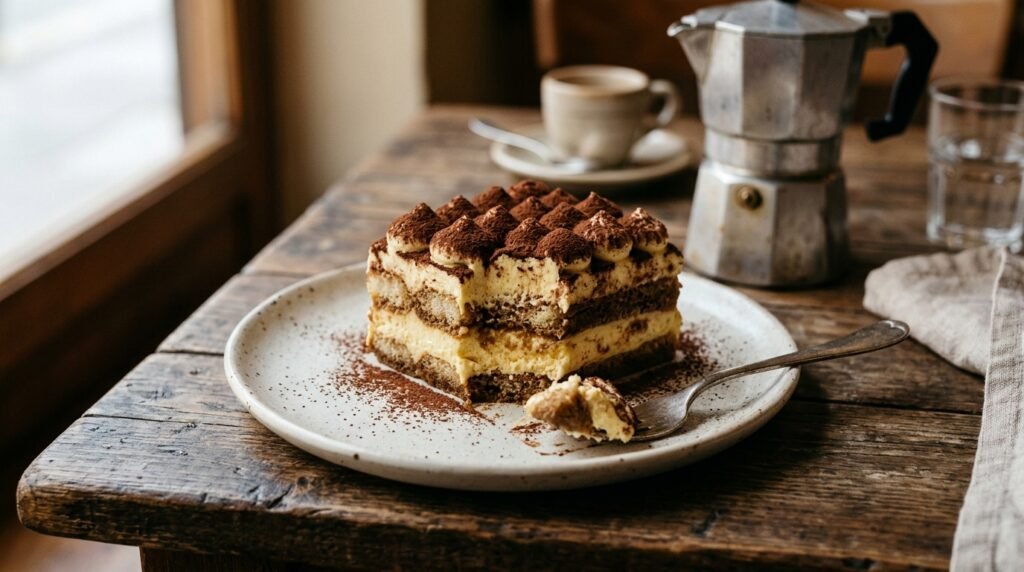
There is no dessert in the pantheon of Italian pastry more revered, misunderstood, or transcendent than an authentic tiramisu recipe. Born in the rolling hills of the Veneto region of Northern Italy—specifically the historic city of Treviso—tiramisu literally translates to “pick me up” or “lift me up,” an affectionate nod to the restorative synergy of dark roasted espresso and nutrient-rich egg yolks. When prepared according to classical Italian culinary doctrine, tiramisu is neither heavy nor soggy; it is an ethereal, featherlight masterpiece of espresso-soaked savoiardi ladyfingers enveloped in a cloud-like, velvety mascarpone sabayon cream, finished with a bitter dusting of premium dark Dutch-processed cocoa powder.
The True Philosophy of Traditional Treviso Tiramisu
Modern commercial adaptations often adulterate tiramisu with heavy gelatin, stabilizing whipped topping, cream cheese substitutes, or artificial coffee syrups. In true Italian home kitchens and Michelin-starred trattorias, an authentic tiramisu recipe relies on the pure alchemy of five humble, high-quality ingredients: farm-fresh egg yolks, granulated sugar, Italian mascarpone cheese, crisp Italian Savoiardi ladyfingers, and freshly brewed stovetop moka espresso.
Much like mastering our beloved San Sebastian Burnt Basque Cheesecake or the delicate crumb of our Classic New York Style Cheesecake, the magic of tiramisu lies in the delicate preservation of dairy emulsion and the precise timing of the cookie dip. In this masterclass guide, you will master the double-boiler sabayon pasteurization method, discover why Italian Savoiardi can never be replaced by soft sponge cake, and learn the exact overnight resting time required to transform individual ingredients into a harmonious culinary symphony.
Essential Ingredients for the Ultimate Tiramisu
| Ingredient | Metric Measurement | US Customary | Culinary Purpose & Quality Notes |
|---|---|---|---|
| Italian Mascarpone | 500g (chilled) | 17.6 oz (approx. 2 cups) | Must be imported triple-cream Italian mascarpone; never low-fat cream cheese |
| Large Egg Yolks | 6 egg yolks (approx. 110g) | 6 large yolks (room temp) | Pasture-raised organic eggs provide rich golden color and emulsifying lecithin |
| Granulated Sugar | 130g | 2/3 cup | Dissolves into egg yolks to create a stable, airy sabayon custard base |
| Heavy Whipping Cream (36%+) | 240ml | 1 cup (cold) | Whipped to soft-medium peaks to fold into the mascarpone for a cloud-like texture |
| Italian Savoiardi Ladyfingers | 300g (approx. 30–36 cookies) | 1 large package | Hard, sugar-crusted dried Italian ladyfingers; soft bakery ladyfingers turn to mush |
| Freshly Brewed Espresso | 360ml (room temperature) | 1 1/2 cups | Dark Italian roast brewed via Moka pot or espresso machine; never instant granules |
| Marsala Wine or Dark Rum (Optional) | 45ml | 3 tablespoons | Traditional Sicilian dry or semi-sweet Marsala wine imparts complex woody undertones |
| Dutch-Processed Cocoa Powder | 30g | 1/4 cup | Unsweetened high-fat Valrhona or Guittard cocoa powder for intense bittersweet finish |
The Science of Tiramisu: Savoiardi vs. Soft Sponge Ladyfingers
The single most catastrophic mistake in amateur tiramisu preparation is selecting the wrong cookie base. In North American and European grocery aisles, you will encounter two vastly different products sold as “ladyfingers”:
- Italian Savoiardi (The Only Correct Choice): These are bone-dry, ultra-crisp, sugar-encrusted biscuit fingers manufactured through prolonged low-temperature dehydration. Their bone-dry crumb contains microscopic air channels designed to absorb liquid through capillary action like a dry sponge. When dipped quickly into hot espresso, they hydrate without disintegrating, softening during an overnight chill into a texture identical to delicate genoise sponge cake.
- Soft Bakery Ladyfingers (Avoid Completely): Soft, cakey ladyfingers sold in plastic trays already contain 20% to 25% moisture. Dipping these into espresso instantly collapses their delicate gluten structure, resulting in an unappetizing, soupy porridge beneath your cream.
Step-by-Step Master Method (With Pasteurized Sabayon)
Phase 1: Preparing the Espresso Soaking Bath
Brew 360ml (1 1/2 cups) of robust dark roast espresso. Pour the hot espresso into a wide, shallow ceramic baking dish to maximize cooling surface area. Stir in 1 tablespoon of sugar until dissolved, followed by 45ml of Marsala wine or dark aged rum if desired. Allow the coffee mixture to cool completely to room temperature before assembling. Dipping cookies into piping hot espresso dissolves their outer sugar crust too quickly, leading to soggy layers.
Phase 2: Whisking the Pasteurized Sabayon
To eliminate any salmonella concerns while creating an ultra-silky foundation, place 6 large egg yolks and 130g of granulated sugar into a large heatproof stainless-steel or glass bowl. Set the bowl over a saucepan filled with 2 inches of gently simmering water (bain-marie), ensuring the bottom of the bowl does not touch the simmering water.
Whisk continuously and vigorously with a balloon whisk for 6 to 8 minutes. The mixture will transition from dark yellow to a pale, luminous ivory ribbon, doubling in volume and reaching 71°C (160°F) on a digital candy thermometer. Remove from heat immediately and let cool for 5 minutes, whisking occasionally.
Phase 3: Incorporating the Mascarpone & Whipped Cream
In a separate chilled bowl, whip 240ml of cold heavy cream until soft-medium, pillowy peaks form. In another bowl, gently fold the chilled mascarpone with a rubber spatula to loosen its density (never over-beat mascarpone with an electric mixer at high speed, or the delicate milk fat will separate into curds and whey). Gently fold the loosened mascarpone into the warm sabayon custard in three additions until completely smooth and satiny. Finally, gently fold in the whipped cream in broad, sweeping motions until a uniform, cloud-like mousse is formed.
Phase 4: The 1-Second Dipping Rule & Layering Architecture
Mastering the dip is an art form. Pick up an Italian Savoiardi cookie. Submerge it into the room-temperature espresso bath for exactly one second total—half a second on the flat side, half a second on the rounded sugar side. Do not let it soak. The cookie should feel firm and crisp on the outside when placed into the baking pan; the moisture will migrate evenly into the interior core during the overnight rest.
Arrange a single tight layer of dipped cookies across the bottom of a 9×13 inch glass or ceramic dish, breaking cookies as needed to fill any gaps. Spread half of the velvety mascarpone cream evenly over the cookies using an offset spatula. Repeat with a second layer of 1-second dipped savoiardi, placing them perpendicular to the first layer for structural stability. Top with the remaining mascarpone cream, smoothing the top or piping decorative rosettes with a round pastry tip.
Phase 5: The Crucial Overnight Chill & Cocoa Finish
Cover the dish tightly with plastic wrap and refrigerate for a minimum of 8 hours, though 16 to 24 hours yields optimal flavor maturation. During this restful hibernation, the gelatinized starches in the cookies absorb moisture from the cream, firming the structure so clean, immaculate rectangular slices can be cut with a chef’s knife. Immediately before serving, dust the surface generously with Dutch-processed cocoa powder using a fine-mesh tea strainer.
Pro Baker Troubleshooting Guide
| Issue Encountered | Root Culinary Cause | How to Prevent / Rectify |
|---|---|---|
| Watery / Runny Cream | Mascarpone was over-whipped or warm cream was used | Fold mascarpone gently by hand; always whip heavy cream while ice cold |
| Soggy / Mushy Bottom Layer | Ladyfingers were submerged longer than 1–2 seconds | Count “one-one-thousand” and remove immediately; cookie must feel firm |
| Dry / Crumbly Cookies Inside | Espresso bath was ice-cold or dip was too brief | Ensure espresso is at room temperature (not chilled) so starches hydrate |
| Grainy / Curdled Sabayon | Egg yolks cooked too fast on direct high heat | Keep water at a gentle simmer; never allow water to touch bottom of bowl |
Frequently Asked Questions (FAQ)
Can I make tiramisu without alcohol?
Yes, absolutely. Classical Veneto recipes from the 1960s were originally alcohol-free to allow children and elderly family members to enjoy the dessert. Simply omit the Marsala wine or rum, adding 1 teaspoon of pure vanilla extract or a dash of hazelnut extract to the espresso bath.
How long does homemade tiramisu stay fresh?
Homemade tiramisu reaches its absolute peak texture and flavor between 24 and 48 hours after assembly. Stored tightly covered in the refrigerator, it will keep impeccably for up to 5 days. You can also freeze tiramisu without cocoa powder for up to 2 months; thaw overnight in the refrigerator before dusting with cocoa.
Looking for more rich chocolate and coffee inspirations? Explore our decadent Brown Butter Espresso Brownies and the irresistible molten center of our Warm Molten Chocolate Lava Cake.
