

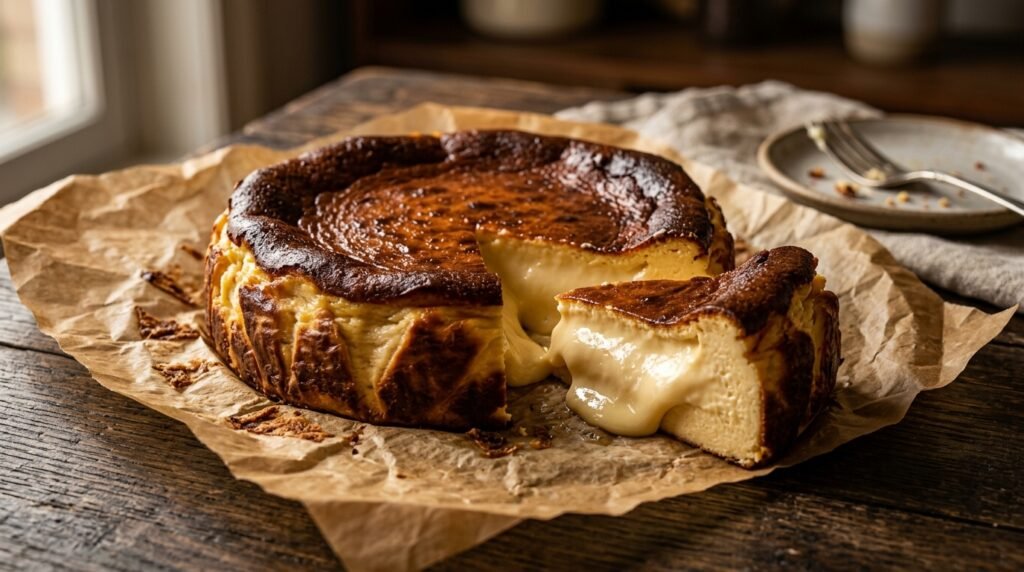
Hailing from the legendary pintxos bars of San Sebastián in Spain’s Basque Country—specifically the iconic La Viña bar—the san sebastian burnt basque cheesecake has conquered the global culinary world. Defying every traditional American cheesecake rule, this breathtaking dessert requires no water bath, no cookie crust, and zero fear of high heat. Baked at a scorching 425°F (218°C), the exterior deeply caramelizes into a bitter-sweet mahogany crust, while the interior remains extraordinarily creamy, custardy, and molten. Every slice delivers a mesmerizing contrast of toasted brûlée complexity and silky cream cheese decadence.
Table of Contents
The Rebellious Genius of the Basque Cheesecake
Invented in the early 1990s by chef Santiago Rivera at La Viña, the Basque cheesecake flips traditional patisserie upside down. While French and American chefs obsess over preventing any browning on cheesecake surfaces, the Basque method intentionally scorches the exterior. Through intense caramelization and high-temperature Maillard reactions, the dairy sugars and proteins develop deep notes of toasted hazelnut, salted caramel, and roasted marshmallow. This pleasant bitterness balances the natural richness of high-fat cream cheese, eliminating any need for sugary glazes or fruit toppings.
The 5-Ingredient Authentic Basque Formula
Authentic Basque cheesecake relies on purity and simplicity. Weigh your ingredients accurately for the exact texture:
| Ingredient | Metric Weight | US Measure | Patisserie Function |
|---|---|---|---|
| Full-Fat Cream Cheese (Philadelphia brick) | 900 g | 32 oz (4 blocks), room temp | Smooth, rich, luscious foundation |
| Granulated White Cane Sugar | 280 g | 1 1/3 cups | Sweetness & surface caramelization |
| Large Whole Eggs (Room Temp) | 300 g | 6 large whole eggs | Custard structure & silky coagulation |
| Heavy Whipping Cream (minimum 36% fat) | 450 ml | 1 3/4 cups + 2 tbsp | Fluidity and melt-in-your-mouth creaminess |
| All-Purpose Flour | 25 g | 3 level tablespoons | Minimal starch just to prevent total collapse |
| Fine Sea Salt | 3 g | 1/2 tsp | Essential flavor amplifier |
| Pure Vanilla Bean Paste (Optional) | 5 ml | 1 tsp | Subtle aromatic warmth |
The Parchment Paper Technique for Dramatic Ruffled Edges
The signature rustic appearance of Basque cheesecake comes from crumpled parchment paper. Take two large sheets of baking parchment paper (about 16×16 inches). Crumple both sheets into tight balls under running tap water or with dry hands, then unfold them. Press both overlapping sheets firmly into a 9-inch springform or cake pan, allowing the rustic, wrinkled paper edges to extend 2 to 3 inches above the pan rim. The crumpled paper creates natural creases that trap caramel and prevent the liquid batter from sticking.
Step-by-Step High-Heat Baking Instructions
- Preheat Oven to High Heat: Preheat your oven to 425°F (218°C) conventional. Position your oven rack in the center or upper-middle position. Line your 9-inch pan with crumpled parchment as described above.
- Cream Cheese & Sugar: In your stand mixer fitted with the paddle attachment, beat the softened cream cheese and sugar on medium-low speed for 2 minutes until completely smooth and free of lumps.
- Add Eggs One at a Time: Add the room-temperature eggs one at a time, mixing on low speed for 20 seconds after each addition until incorporated. Scrape the sides of the bowl.
- Stream in Heavy Cream: On low speed, slowly pour in the heavy cream, fine sea salt, and vanilla bean paste. Mix until a silky, pourable custard forms.
- Sift in Flour: Sift the 25g of all-purpose flour over the batter. Fold gently with a spatula or mix on low for 15 seconds just until incorporated. Do not over-beat!
- Pour and Tap: Pour the liquid batter into the prepared parchment-lined pan. Tap the pan firmly against the counter three times to pop any large air bubbles.
- Bake to Mahogany Perfection: Bake at 425°F (218°C) for 50 to 55 minutes. Keep an eye on the top during the final 10 minutes: the crown should puff up dramatically like a soufflé and turn a deep, dark mahogany brown with black blistered spots around the edges.
- The Essential Basque Jiggle: When you gently nudge the pan, the outer 1.5 inches should be set, but the entire center should jiggle dramatically like a bowl of loose pudding. This ensures the center stays gooey and molten upon cooling.
Mastering the Jiggle: How to Judge Doneness
Over-baking is the single most common mistake with Basque cheesecake. If you bake it until the center feels firm or dry, you will end up with a standard baked cheesecake that lacks the signature molten lava interior. Trust the jiggle! As the cheesecake cools, residual heat continues to gently set the custard.
Serving Temperature: Why Room Temp is King
While standard New York cheesecake must be served refrigerator-cold, authentic San Sebastián cheesecake is traditionally enjoyed at cool room temperature. Let the baked cheesecake cool on a wire rack for 4 to 5 hours. As it cools, the puffed top will sink down, creating its iconic crinkled rustic basin. Slicing at room temperature allows the center to ooze luxuriously onto the plate. If refrigerated, always remove it 1 to 2 hours before serving!
Troubleshooting Basque Cheesecake Textures
| Issue | Cause | Solution |
|---|---|---|
| Top is pale and not burnt | Oven was not hot enough, or rack was too low | Ensure oven reaches true 425°F (218°C); position rack in upper third during final 5 minutes or turn on broiler for 90 seconds. |
| Center is completely liquid and won’t hold shape | Cheesecake was cut while still warm, or underbaked | Allow to rest at room temp for at least 4 hours before slicing; chill for 2 hours if extra stability is desired. |
| Center is dry and rubbery | Baked for more than 60 minutes | Remove when the center still jiggles vigorously (at 50-55 min mark). |
Frequently Asked Questions (FAQ)
Does the burnt top taste bitter or like carbon?
Not at all! Because the caramelization comes from dairy sugars and cream cheese proteins, it tastes like rich roasted caramel, crème brûlée crust, and toasted marshmallows—never acrid or smoky.
Can I make this gluten-free?
Yes! Simply substitute the 25g of all-purpose flour with 20g of cornstarch or gluten-free 1-to-1 baking flour.
👩🍳 Related Recipes & Recommended Reading
Discover more international dessert masterclasses and artisanal confections across our kitchen archives:
- Try our traditional classic: Classic New York Style Cheesecake with Berry Compote.
- Savor crunchy Middle Eastern crunch: Dubai Chocolate Cheesecake Bars with Crispy Kataifi.
- Explore rich molten desserts like our Warm Molten Chocolate Lava Cake.
- For curated European baking tutorials and gourmet patisserie recipes, visit our friends at Jowel Recipes (Gourmet Kitchen & Baking Guides).
