

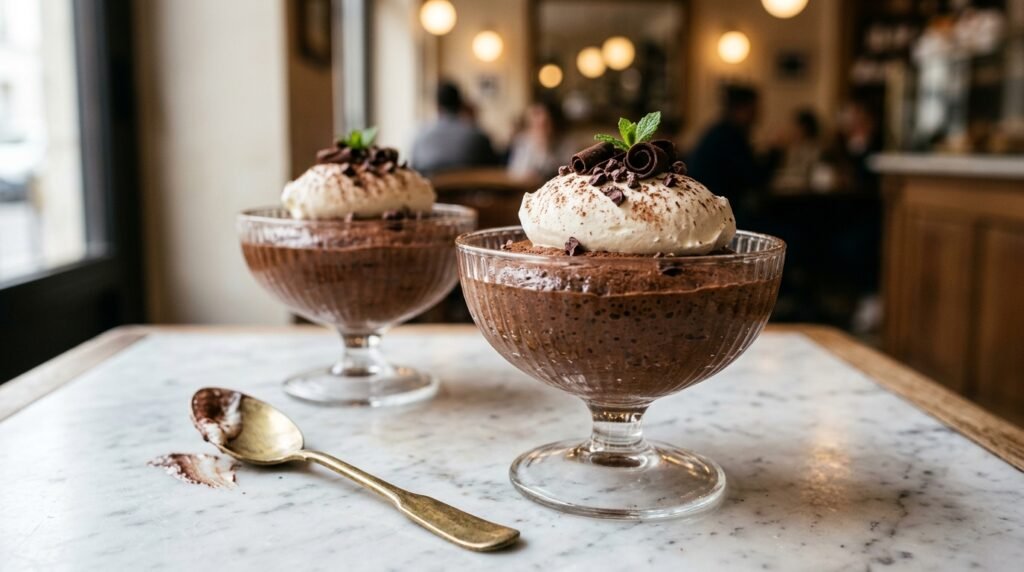
In the grand lexicon of classical French gastronomy, few culinary creations evoke pure sensory bliss like an authentic french chocolate mousse recipe (Mousse au Chocolat). When executed with patisserie precision, traditional French chocolate mousse is not a dense pudding or a heavy whipped cream concoction; it is an impossibly light, airy, cloud-like mousse punctuated with microscopic air pockets that melt instantly upon contact with your tongue into deep, bittersweet chocolate decadence. By harmonizing high-percentage dark chocolate with whipped egg yolks and billowy, stiff egg whites, you will master the pinnacle of French dessert simplicity.
The Timeless Elegance of Mousse au Chocolat
First recorded in French royal banquet menus during the 18th century as mousse de chocolat, this iconic confection achieved international acclaim when post-impressionist painter Henri de Toulouse-Lautrec famously formulated his own artisanal variant in Montmartre, Paris. The essence of great mousse lies in restraint: avoiding gelatin, artificial stabilizers, and excessive heavy cream, allowing the complex fruity, roasted notes of fine cacao beans to shine through.
Much like crafting our beloved Triple Chocolate Fudgy Brownies or the luxurious layers of our Chocolate Raspberry Layer Cake, understanding chocolate crystallization and delicate egg folding technique guarantees an airy mousse that sets with structural elegance without ever collapsing.
Key Ingredients & Cacao Selection
| Ingredient | Metric Measurement | US Customary | Culinary Function & Recommendation |
|---|---|---|---|
| High-Quality Bittersweet Chocolate (70% Cacao) | 200g (finely chopped) | 7 oz (bar chocolate) | Use Valrhona Guanaja, Callebaut 70-30-38, or Guittard; avoid chocolate chips containing emulsifiers |
| Unsalted European Butter (82% fat) | 45g (cubed) | 3 tablespoons | Imparts gloss, rounds out harsh chocolate tannins, and promotes silkiness |
| Large Eggs (Separated) | 4 large eggs (room temp) | 4 egg yolks + 4 egg whites | Yolks provide rich emulsion; whipped whites form the airy structural honeycomb |
| Granulated Sugar | 35g | 3 tablespoons | Beaten into the egg whites to stabilize the foam and prevent weeping |
| Espresso Powder or Strong Coffee | 15ml (1 tbsp brewed espresso) | 1 tablespoon | Amplifies the roasted notes of dark chocolate without imparting coffee flavor |
| Pure Vanilla Extract | 5ml | 1 teaspoon | Rounds out the finish with warm floral notes |
| Fine Sea Salt | 1g | Pinch (1/8 tsp) | Electrolyte that heightens chocolate richness and cuts sweetness |
The Molecular Physics of Mousse Folding
The structural magic of chocolate mousse relies on trapping millions of microscopic air bubbles inside a delicate matrix of denatured egg white proteins (ovalbumin), then gently folding that foam into melted chocolate without deflating the volume or seizing the fats. Two critical temperature thresholds dictate your success:
- The Chocolate Temperature (40°C–45°C / 105°F–113°F): If melted chocolate is folded while piping hot above 50°C, it will instantly cook the egg whites and melt the whipped foam into liquid. Conversely, if allowed to cool below 32°C, the cocoa butter will solidify on contact with the cooler eggs, resulting in gritty, hard chocolate specks.
- The Sacrificial Third Folding Technique: Never fold all egg whites into the dense chocolate at once. You must first fold one-third of the whipped egg whites vigorously into the chocolate base. This “sacrificial” addition lightens the density of the chocolate, allowing the remaining two-thirds of the delicate whites to be folded gently without loss of aeration.
Step-by-Step Classic French Method
Step 1: Melting the Chocolate & Butter Emulsion
Finely chop 200g of 70% dark bittersweet chocolate. Place the chocolate and 45g of cubed European unsalted butter into a heatproof bowl set over a small saucepan of barely simmering water (bain-marie), ensuring the water never touches the bottom of the bowl. Stir gently with a silicone spatula until completely melted, glossy, and smooth. Stir in 1 tablespoon of warm espresso, 1 teaspoon of vanilla extract, and a pinch of fine sea salt. Remove from heat and allow to cool to lukewarm (approx. 40°C / 105°F).
Step 2: Whisking in the Egg Yolks
Carefully separate 4 large eggs while cold, placing the whites in a spotless, grease-free glass or copper bowl, and the yolks in a small ramekin. Allow eggs to come to room temperature for 15 minutes. Once the melted chocolate has cooled to lukewarm, whisk in the 4 egg yolks one at a time until completely incorporated. The chocolate mixture will thicken noticeably into a rich, glossy paste.
Step 3: Whipping the French Meringue
Ensure your whisk attachment and bowl are completely free of oil or egg yolk traces (any fat prevents egg whites from reaching full volume). Whip the 4 egg whites on medium speed until foamy. With the mixer running, gradually shower in 35g of granulated sugar, one tablespoon at a time. Increase speed to medium-high and whip until firm, glossy peaks form that stand straight when the whisk is lifted (do not over-whip until dry or curdled).
Step 4: The Art of the Fold
Scoop one-third of the whipped egg whites into the chocolate yolk base. Using a flexible rubber spatula, stir thoroughly to lighten the base. Next, gently spoon the remaining egg whites on top. Cut down through the center of the bowl with your spatula, sweep along the bottom, bring the spatula up the side of the bowl, and fold over the top, rotating the bowl 90 degrees with each stroke. Continue this gentle J-stroke folding motion until no streaks of white remain, stopping the instant the mousse is uniform.
Step 5: Portioning & Overnight Maturation
Divide the velvety mousse gently among 6 vintage glass dessert coupes, ramekins, or ceramic pots de crème. Cover each glass with plastic wrap and chill in the refrigerator for a minimum of 6 hours (or preferably overnight for 12 hours). During this chill, the cocoa butter sets and the microscopic air bubbles lock in place, yielding an impossibly light, melt-in-your-mouth texture. Garnish before serving with freshly whipped vanilla chantilly cream, dark chocolate curls, and flaky sea salt.
Frequently Asked Questions (FAQ)
Are the raw eggs safe to consume in traditional chocolate mousse?
Traditional French mousse relies on raw whipped egg whites for its signature lightness. When using fresh, pasteurized, high-grade eggs stored properly under refrigeration, the risk of foodborne illness is negligible. However, if serving pregnant women, the elderly, or immunocompromised individuals, purchase carton-pasteurized egg whites or prepare an Italian-meringue cooked variation.
Can I make chocolate mousse with milk chocolate?
While possible, milk chocolate contains significantly more sugar and less cocoa butter (around 30%–38% cacao), which yields a noticeably softer, sweeter, and denser mousse that struggles to hold structure. For optimal patisserie balance, we recommend dark chocolate containing between 60% and 72% cacao.
Pair this French classic with our Bakery-Style Red Velvet Stuffed Cookies and our popular Fudgy Tahini Brownies.
