

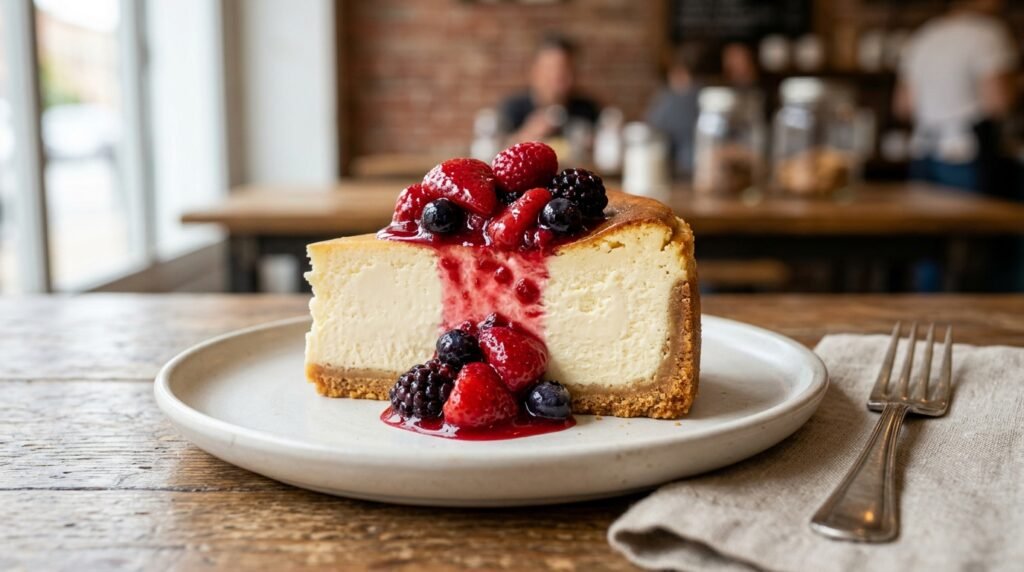
Few desserts in the global culinary canon evoke such pure, timeless reverence as an authentic classic new york cheesecake recipe. Towering, ultra-dense, and luxuriously velvety, a genuine New York cheesecake stands apart from fluffy ricotta pies or gelatin-set no-bake confections. It is an unapologetically rich masterpiece baked with full-fat Philadelphia cream cheese, cultured sour cream, egg yolks, and pure Madagascar vanilla bean caviar over a crisp, buttery graham cracker crust. In this comprehensive masterclass guide, we demystify the water bath technique and reveal the precise cooling curve that guarantees a flat, glass-smooth top without a single crack.
Table of Contents
The Chemistry of a Crack-Free Cheesecake Custard
Technically speaking, a baked cheesecake is not a cake at all—it is a baked dairy custard. Understanding protein coagulation is the secret to bakery-level success:
- Gentle Heat Transfer via Bain-Marie (Water Bath): Water cannot exceed its boiling point of 212°F (100°C) at atmospheric pressure. Surrounding your springform pan with hot water insulates the delicate cream cheese emulsion, preventing the outer edges from curdling or overcooking while the center gently sets.
- Minimal Air Incorporation: Whisking air into cheesecake batter is the leading cause of surface fissures! When air bubbles heat up in the oven, they expand and rise, causing the cheesecake to balloon like a soufflé. Upon cooling, the cake collapses, leaving large unsightly cracks. Always mix cheesecake batter on the lowest speed with a paddle attachment.
- The Sour Cream and Cornstarch Stabilizer: Adding a small amount of cornstarch (15g) binds to free moisture and physically separates egg proteins, preventing them from over-coagulating into rubbery curds. Cultured sour cream adds lactic tang while smoothing the rich butterfat profile.
Baker’s Precision Ingredient Formulation
| Component | Ingredient | Metric Weight | US Volume |
|---|---|---|---|
| Crust | Graham Cracker Crumbs | 200 g | 1 1/2 cups finely crushed |
| Crust | Granulated Sugar | 35 g | 3 tbsp |
| Crust | Unsalted Butter (melted) | 85 g | 6 tbsp |
| Crust | Fine Sea Salt | 2 g | 1/4 tsp |
| Filling | Full-Fat Cream Cheese (Philadelphia brick, room temp) | 900 g | 32 oz (4 standard 8-oz blocks) |
| Filling | Granulated Extra-Fine Sugar | 250 g | 1 1/4 cups |
| Filling | Sour Cream (full-fat, room temp) | 240 g | 1 cup |
| Filling | Cornstarch | 15 g | 2 tbsp |
| Filling | Fresh Lemon Juice | 15 ml | 1 tbsp |
| Filling | Madagascar Vanilla Bean Paste | 10 ml | 2 tsp |
| Filling | Large Eggs (Room Temp) | 200 g | 4 large eggs |
| Filling | Large Egg Yolk | 20 g | 1 large egg yolk (for silkiness) |
The Golden Rule of Butter-Pressed Graham Crust
A soggy or crumbly crust ruins an otherwise exquisite cheesecake. Mix the crushed graham crumbs, sugar, fine sea salt, and melted butter until it resembles wet beach sand. Press the mixture firmly across the bottom and 1 inch up the sides of a 9-inch heavy-gauge springform pan using the flat bottom of a metal measuring cup. Blind-bake the crust at 350°F (177°C) for 10 minutes until fragrant and lightly toasted. Let cool completely before pouring in the cheese filling.
Step-by-Step Water Bath Baking Tutorial
- Room Temperature Ingredients (Crucial): Take your cream cheese, sour cream, and eggs out of the refrigerator 2 to 3 hours before baking. Cold cream cheese will result in persistent white lumps that cannot be smoothed out without over-whipping air into the batter.
- Smooth the Cream Cheese Base: In a stand mixer fitted with the paddle attachment, beat the softened cream cheese on low speed for 2 minutes until completely smooth and satiny.
- Add Sugar and Cornstarch: Whisk the sugar and cornstarch together, then gradually add to the cream cheese on lowest speed for 1 minute until completely dissolved. Scrape the sides and bottom of the bowl thoroughly with a silicone spatula.
- Incorporate Sour Cream, Lemon & Vanilla: Add the full-fat sour cream, fresh lemon juice, and vanilla bean paste. Mix on low speed just until blended.
- Gently Add Eggs One by One: Add the room-temperature eggs and egg yolk one at a time, mixing on lowest speed just until each yolk disappears. Do not over-mix! Tap the bowl gently on the counter three times to release any trapped air bubbles.
- Waterproof the Springform Pan: Wrap the exterior of your 9-inch springform pan with two layers of heavy-duty aluminum foil, followed by an oven-safe silicone baking bag (or roasting bag) to guarantee zero water seepage. Pour the batter over the pre-baked crust and smooth the top with an offset spatula.
- Assemble Bain-Marie: Place the wrapped pan inside a large high-sided roasting pan. Pour boiling water into the roasting pan until it reaches halfway up the sides of the cheesecake pan (about 1.5 inches deep).
- Bake Gently: Bake at 325°F (163°C) conventional for 75 to 85 minutes. The cheesecake is done when the outer 2.5-inch rim is set and firm, but the very center (about 2 inches across) still wobbles gently like set gelatin when the pan is nudged. (Internal temp: 150°F–155°F / 65°C–68°C).
Glistening Fresh Triple-Berry Compote Coulis
To cut through the opulent richness of the New York cheesecake, serve with a vibrant ruby berry coulis. In a small saucepan, combine 150g fresh raspberries, 100g sliced strawberries, 50g blueberries, 50g sugar, 15ml fresh lemon juice, and 5g cornstarch dissolved in 1 tbsp cold water. Simmer gently over medium heat for 4 minutes until the berries burst into a glossy, fragrant compote. Cool completely in the refrigerator before spooning over chilled cheesecake slices.
The Critical Multi-Stage Cooling Schedule
Rapid temperature changes are the enemy of cheesecake! Follow this professional 3-stage cooling curve:
- Stage 1 (Oven Rest – 1 Hour): When baking time is complete, turn off the oven. Crack the oven door open 1 inch (prop with a wooden spoon) and let the cheesecake rest undisturbed inside the water bath for 60 minutes. This allows the internal temperature to decline gradually.
- Stage 2 (Countertop Cool – 1 Hour): Remove the cheesecake from the water bath, strip off the foil, and run a thin paring knife gently around the inside rim of the pan (this prevents the cake from clinging to the sides as it contracts). Let it cool to room temperature on a wire rack for 1 hour.
- Stage 3 (Refrigeration – 8 to 12 Hours): Cover loosely and chill in the refrigerator for at least 8 hours (preferably overnight). This chill time is mandatory for the butterfat and proteins to set into that signature dense, velvety New York mouthfeel.
Troubleshooting Cracks, Sinking, and Grainy Texture
| Flaw | Underlying Cause | Correction |
|---|---|---|
| Deep crack down the center | Over-baked (internal temp exceeded 160°F), cooled too rapidly, or whipped too much air into batter | Remove when center still jiggles; cool inside propped oven for 1 hour; always mix on lowest speed. |
| Soggy, waterlogged crust | Water bath leaked through aluminum foil seams | Use wide 18-inch heavy-duty foil or an oven-safe silicone pan liner shield. |
| Grainy, curdled mouthfeel | Cheesecake was baked without a water bath or at too high a temperature | A gentle 325°F bain-marie is non-negotiable for smooth custard texture. |
Frequently Asked Questions (FAQ)
Can I freeze whole New York cheesecake?
Yes, baked New York cheesecake freezes exceptionally well for up to 2 months. Freeze the thoroughly chilled cake solid on a cardboard round, wrap in two layers of plastic wrap and aluminum foil. Thaw in the refrigerator overnight before slicing.
👩🍳 Related Recipes & Recommended Reading
Explore more decadent cheesecake and bakery creations across our kitchen collection:
- Try our viral sensation: Dubai Chocolate Cheesecake Bars with Crispy Kataifi.
- Love berries and cream? Bake our elegant Strawberry Cream Cake Recipe.
- For cocoa lovers, savor our Decadent Cream Cheese Swirl Brownies.
- For professional pastry techniques and gourmet dessert guides, visit our culinary partners at Jowel Recipes (Gourmet Kitchen & Baking Guides).
