

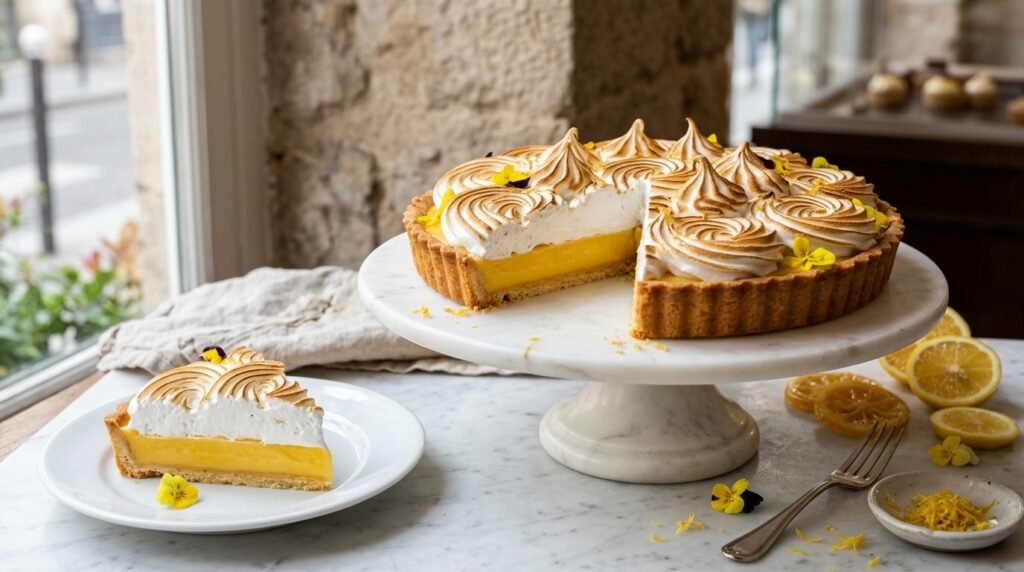
Few pastry creations in the patisserie display cases of Paris demand adoration quite like a magnificent lemon meringue tart recipe (Tarte au Citron Meringuée). A master study in textural and flavor contrast, this French confectionery icon pairs a crisp, buttery, melt-in-your-mouth sweet shortcrust pastry (pâte sablée) with an intensely tart, vibrant lemon curd and billowy, glossy peaks of caramelized Swiss meringue. When executed with classical French technique, every forkful delivers an exquisite dance between buttery crunch, zesty citrus acidity, and marshmallowy sweetness.
The Anatomy of Patisserie-Grade Tarte au Citron
Dating back to 19th-century French regional baking traditions, the lemon meringue tart gained international immortality when legendary French pastry chef Pierre Hermé reimagined the lemon curd emulsion. Rather than cooking butter directly with the citrus juice on the stove—which can result in a greasy, separated curd—modern French technique whips chilled butter into the warm lemon custard off the heat, creating an ultra-stable, silky velvet emulsion.
Together with our beloved tart creations like the Mini Lemon Raspberry Tartlets and our vibrant Cherry Curd Tart with Shortbread Crust, this comprehensive guide will teach you the art of blind-baking without crust shrinkage, emulsifying silky lemon curd, and whipping stable Swiss meringue that never weeps.
Ingredients for Crust, Curd & Swiss Meringue
| Component | Ingredient | Metric Measurement | US Customary | Patisserie Notes |
|---|---|---|---|---|
| Pâte Sablée Crust | All-Purpose Flour | 200g | 1 2/3 cups (sifted) | Low-protein pastry flour yields a tender, sandy “sablée” crumb |
| Pâte Sablée Crust | Unsalted European Butter | 100g (cold, cubed) | 7 tablespoons | 82% butterfat European butter creates flaky, rich pastry walls |
| Pâte Sablée Crust | Confectioners’ Powdered Sugar | 65g | 1/2 cup (sifted) | Powdered sugar contains cornstarch, preventing gluten formation and shrinkage |
| Pâte Sablée Crust | Large Egg Yolk & Pinch Salt | 1 large yolk (20g) + 2g salt | 1 egg yolk + 1/4 tsp salt | Binds the dough into a pliable, tender disk |
| Silky Lemon Curd | Fresh Eureka Lemon Juice | 160ml (freshly squeezed) | 2/3 cup | Never use bottled juice; fresh lemon juice provides bright natural acidity |
| Silky Lemon Curd | Finely Grated Lemon Zest | Zest of 3 unwaxed lemons | 2 tablespoons | Rich in essential lemon oils (limonene) for fragrant citrus aroma |
| Silky Lemon Curd | Granulated Sugar | 160g | 3/4 cup + 1 tbsp | Sweetens the curd and tenderizes egg protein coagulation |
| Silky Lemon Curd | Large Whole Eggs + Yolks | 3 whole eggs + 2 egg yolks | 3 large eggs + 2 yolks | Provide thickening power and luxurious golden color |
| Silky Lemon Curd | Unsalted Butter (chilled, cubed) | 150g | 10.5 tablespoons | Emulsified into warm curd off heat for a glossy, velvet texture |
| Swiss Meringue | Large Egg Whites | 4 egg whites (approx. 130g) | 4 large whites (room temp) | Whips into stable, voluminous marshmallow peaks |
| Swiss Meringue | Granulated Sugar & Cream of Tartar | 200g sugar + 1g cream of tartar | 1 cup sugar + 1/4 tsp tartar | Dissolved over steam to create pasteurized, weep-free meringue |
The Science of Blind Baking Pâte Sablée Without Shrinkage
The nightmare of tart baking is a pastry crust that slides down the fluted edges of the tart pan into a puddle of butter. To achieve crisp, upright 90-degree pastry walls that hold their shape like marble, follow these three non-negotiable rules:
- The Frasage Technique: After cutting cold butter into the dry flour and powdered sugar, turn the crumbly mixture onto your marble counter. Use the heel of your hand to smear the dough away from you in quick, firm strokes (frasage). This homogenizes the butter and flour without over-developing gluten elasticity.
- The Dual Chill: Chill the dough disk for at least 2 hours before rolling. Once rolled and pressed into your 9-inch fluted tart pan with removable bottom, transfer the lined pan into the freezer for 30 minutes until rock solid. Freezing solidifies the butterfat crystals, preventing slumping during initial oven contact.
- The Full Blind Bake: Line the frozen crust with crumpled parchment paper and fill to the brim with ceramic pie weights or dry beans. Bake at 175°C (350°F) for 20 minutes with weights, remove weights, brush lightly with egg wash to seal the pores, and bake for an additional 10 minutes until deeply golden and bone-dry.
Step-by-Step Patisserie Method
Step 1: Preparing & Baking the Crust
In a food processor, pulse 200g of flour, 65g of powdered sugar, and 1/4 teaspoon of fine salt. Add 100g of cold cubed butter and pulse until a coarse sandy meal forms. Add 1 egg yolk and 1 tablespoon of ice water, pulsing just until the dough gathers into clumps. Shape into a flat disk, wrap in plastic, and chill for 2 hours. Roll out to 3mm thickness on a lightly floured surface, press gently into a 9-inch fluted tart pan with removable bottom, trim the edges flush with the rim, dock the base all over with a fork, and freeze for 30 minutes. Blind bake with pie weights at 175°C (350°F) until crisp and golden brown as outlined above. Let cool completely.
Step 2: Cooking the Pierre Hermé Lemon Curd
In a medium heatproof bowl, rub the fresh lemon zest into 160g of sugar with your fingertips until fragrant and moist. Whisk in 3 whole eggs and 2 egg yolks, followed by 160ml of freshly squeezed lemon juice. Set the bowl over a pot of gently simmering water. Whisk continuously for 8 to 10 minutes until the mixture thickens into a rich curd that coats the back of a spoon and registers 82°C–84°C (180°F) on a thermometer.
Immediately strain the hot curd through a fine-mesh sieve into a clean bowl to remove zest and egg fragments. Allow the curd to cool to 55°C–60°C (130°F–140°F). Using an immersion stick blender or vigorous whisk, incorporate 150g of chilled cubed butter piece by piece. Blend for 2 full minutes until the curd turns pale, glossy, and impossibly silky. Pour the warm curd into the baked tart shell, smooth the top, and refrigerate for at least 3 hours until firmly set.
Step 3: Whipping & Torching the Swiss Meringue
Unlike French meringue (which can weep watery syrup) or Italian meringue (which requires hot boiling sugar syrup), Swiss meringue is both stable and food-safe. In a heatproof mixer bowl, whisk together 4 egg whites, 200g of granulated sugar, and 1/4 teaspoon of cream of tartar. Place over a pot of simmering water, whisking constantly until the sugar granules dissolve completely and the mixture feels smooth and hot (reach 71°C / 160°F on a thermometer).
Transfer the bowl to your stand mixer fitted with the whisk attachment. Beat on medium-high speed for 7 to 9 minutes until the meringue cools to room temperature and forms glossy, stiff, marshmallow-like peaks. Spoon the meringue lavishly over the chilled lemon tart, sculpting dramatic swirls with the back of a spoon, or pipe elegant rosettes using a star pastry tip. Toast the meringue peaks with a kitchen culinary blowtorch until beautifully caramelized with golden-brown edges. Serve chilled.
Frequently Asked Questions (FAQ)
Why did my meringue weep liquid onto the tart?
Meringue weeping occurs when undissolved sugar crystals attract moisture from the air, or when the egg white protein matrix breaks down. By heating the sugar and egg whites to 71°C in our Swiss method, the sugar dissolves 100% and the proteins pasteurize, eliminating weeping for up to 48 hours.
Can I prepare the lemon meringue tart ahead of time?
The baked crust and lemon curd filling can be assembled and refrigerated up to 2 days in advance. For the absolute best visual presentation and textural contrast, whip, pipe, and torch the Swiss meringue on the day of serving.
Explore more delightful bakery-style treats with our Easy Ube Mochi Croissants and our exquisite Small-Batch Passionfruit Layer Cake.
